
As we continue building the BORAsuite ecosystem, one question keeps coming up in almost every conversation with prospective customers: "Can your system work without the internet?"
Honestly, that simple question has forced us to rethink a few foundational assumptions.
From day one, our philosophy has been cloud-first. The goal was straightforward: give business owners the freedom to monitor and manage their operations from anywhere, without needing to be physically present at their shops, pharmacies, restaurants, or offices. Yet the more founders and operators we speak with, the clearer a paradox becomes—the very feature we pitch as our biggest advantage is sometimes the exact reason a customer hesitates to subscribe.
Take Uganda, for example. Businesses here have navigated nationwide internet disruptions, including restrictions around election periods, alongside everyday connectivity drops. Now picture a busy restaurant during a lunch rush when the connection suddenly dies. Should a business stop serving customers simply because its point-of-sale (POS) system cannot reach a cloud server?
Clearly not.
Rethinking a Familiar Technology
That reality check got me thinking about technologies we already have at our disposal—specifically, Bluetooth.
Operating in the 2.4 GHz frequency band, Bluetooth allows nearby devices to communicate directly without requiring an internet connection or even a local router.
While its effective range varies depending on hardware and physical environment, its ability to exchange data peer-to-peer between proximate devices holds untapped potential for business software.
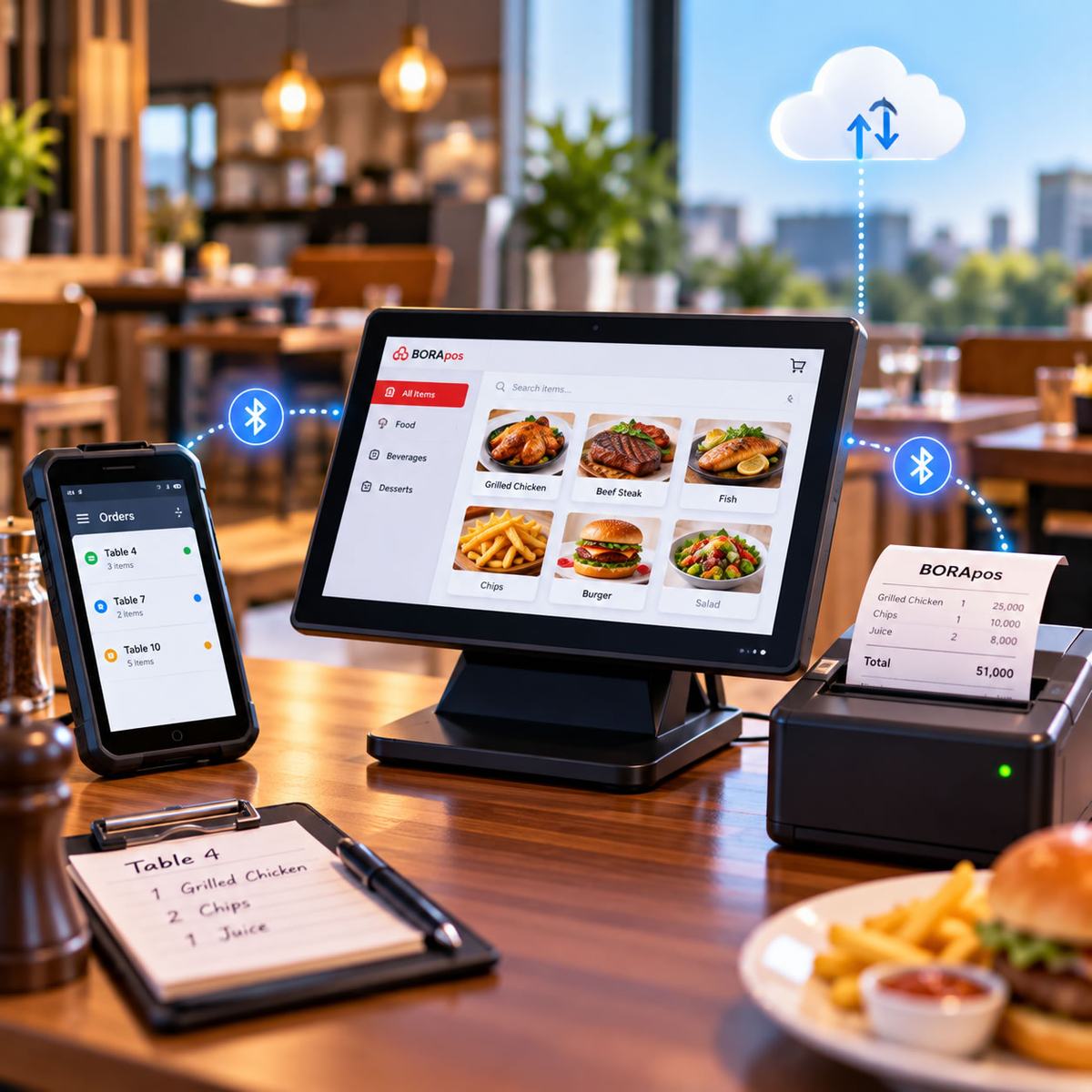
Imagine that same busy restaurant during an outage. Instead of grinding to a halt, the waiter’s tablet, the cashier’s terminal, and the receipt printer continue talking to each other over Bluetooth.
Orders keep flowing, sales are logged locally, and receipts still print. Once internet connectivity returns, those locally stored transactions automatically sync back to the cloud allowing the business owner to pick up remote monitoring right where they left off.
Cloud-First, Not Cloud-Dependent
Of course, making this seamless takes more than Bluetooth alone. It requires deliberate local-first architecture: reliable on-device storage, conflict-free transaction processing, and resilient background synchronization. Still, it raises an important design question for software builders: could Bluetooth play a much bigger role in how we engineer offline capabilities into modern SaaS products?
This is where my own thinking on SaaS is evolving. Cloud-first should not mean cloud-dependent for critical day-to-day operations. Business owners deserve the visibility and power of the cloud without living in fear that every network hiccup will bring their front counter to a standstill.
An Open Question for Builders
For years, developers have relegated Bluetooth to simple peripheral tasks connecting speakers, barcode scanners, and receipt printers. Have we overlooked what it can do beyond basic hardware pairing?
Could it serve as a lightweight local bridge for exchanging orders, sharing transaction states, and coordinating workflows across nearby devices when the internet goes dark?
I am deeply interested in exploring how Bluetooth and offline synchronization can work together to make SaaS platforms genuinely resilient especially for small and medium businesses across African markets.
To fellow developers, infrastructure engineers, and SaaS founders reading this: are we leaving real opportunities on the table with Bluetooth, or do its bandwidth, pairing, and range limitations make it impractical for serious business operations?
After all, true innovation isn't always about chasing brand-new technology. Sometimes, it is about finding a smarter use for the tools we have had all along.