
A failed checkout test can send a developer through a Vue component, a Django API and a database transaction before the cause becomes clear. Halfway through, the developer might discover that the old API response must stay in place because a mobile app still depends on it. That is the kind of job Google is targeting with Gemini 4 Neon, which it introduced on 18 November 2026. A coding agent earns its keep here by tracing the problem across files, adapting to the new requirement and producing a patch someone can review.
It can take a correction halfway through a job
Coding tasks change as developers learn more. A refactor that looked straightforward at the start can uncover a dependency, a backward-compatibility requirement or a test that captures an undocumented business rule. The developer should be able to say “Keep the public API as it is and fix the transaction logic” without having to restart the session or re-explain the repository.
This ability to adapt mid-task is called steerability. On Arena’s steerability leaderboard, Neon at its xhigh setting sat just behind Claude Fable 5.2 and a single point ahead of Claude Opus 5.5. That narrow gap puts the two models close together on this measure. On Arena’s broader agent leaderboard, Neon was provisionally third, behind both Claude models.
The development environment can matter as much as the model
Google built Neon for coding sessions that involve repeated cycles of reading files, making edits, running tools and checking results. In Google Antigravity, Neon can coordinate parallel work by smaller Gemini 4 Hydrogen agents. I
In a web project, that could mean investigating the frontend and backend in parallel before bringing the findings together into one patch. Google also says Neon reduces redundant file reads and can carry work forward when earlier session history is compressed.
The clearest illustration is SWE-sweep. Google reported that Neon scored 12.8% with the Mini-SWE setup and 39.0% in Antigravity. Same model, different environment. That swing matters when choosing a coding assistant. How it searches a repository, manages tool calls and carries context between steps can change what it gets done. A result from Antigravity should therefore be read as a result for the model and its tools together.
A large context window makes it easier to bring the evidence together
Neon’s one-million-token context window supports inputs including text, images, PDFs, audio and video. A developer could give it an issue description, relevant source files and a screen recording of a bug in the same session. For a team maintaining a legacy system, that also means being able to supply a migration guide alongside the code and test logs it describes. OpenAI’s GPT‑6.2 Sol offers a similarly sized context window and accepts text and images, so Neon’s broader range of input types is the more meaningful distinction in this comparison.
Where Neon beats Claude and OpenAI
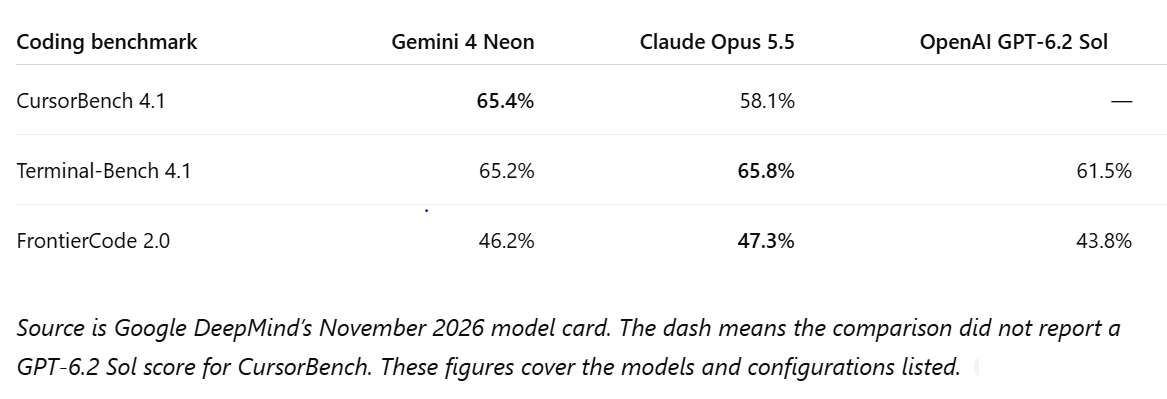
Google DeepMind’s published model card shows Neon’s clearest win on CursorBench 4.1, an evaluation of coding-agent tasks. Claude Opus 5.5 stays slightly ahead on the terminal and FrontierCode tests.
Price changes the comparison. Per million API tokens, Neon costs $3 for input and $15 for output. That puts it below Claude Opus 5.5 at $4 and $20, and above GPT‑6.2 Sol at $2 and $10. Google also prices Neon’s cached input at $0.15 per million tokens, which matters when an agent keeps reusing the same context. For a small software team, the better measure is cost per accepted patch. A cheaper run can become more expensive if it takes several attempts and an afternoon of review.
Is Gemini 4 Neon worth switching to?
Neon is worth trying first on a messy change that spans several files and needs feedback along the way. Its CursorBench result and near-top steerability score make a stronger case for that workload than a general claim that it beats Claude or OpenAI at coding.
Claude Opus 5.5 remains a strong option for terminal-heavy work based on the published results, and GPT‑6.2 Sol has the lowest per-token API rates of the three. Google lists Neon in the Gemini API through AI Studio and in Antigravity for paid Google AI Pro and Ultra subscribers.